Starting a FiveM server is the easy part. Spending money on it sensibly is where most owners come unstuck. The store pages are endless, every script promises to be the one your server needs, and it's frighteningly easy to drop a few hundred before a single player has connected. This is a calm, category-by-category guide to buying without the guesswork - what to get first, what to hold off on, and which store to reach for at each stage.
Budget like the server might not make it
Start with the unsexy truth: most servers don't last. So budget like yours might not, at least until it proves itself. Spend the minimum that gets you a stable, playable server people want to come back to, then reinvest from there. Buying a complete catalog of premium scripts before you have ten regulars is how people end up with a beautifully equipped server that nobody plays.
A sane early budget covers four things: hosting, your core framework setup, a handful of essential gameplay scripts, and a clean look. Everything else - the heists, the custom MLOs, the fifty-car dealership - is phase two, funded by a server that's actually working. Treat your first spend as an experiment, not a monument.
Buy in this order: foundation before flair
The biggest mistake is buying flair before foundation. People get excited and purchase a flashy casino or a gang system before they have the basics that make those things matter. Buy in this order instead:
- Framework and core systems first. Whatever your base - QBCore, ESX, or standalone - get the spine working: jobs, money, inventory, the loop players live in. For QBCore servers specifically, sourcing from a store built around that ecosystem saves you compatibility headaches; a focused source of QBCore scripts and resources means the pieces are made to fit together rather than fought into place.
- The core gameplay loop second. Whatever your server is about - if it's a crime-and-economy server, the jobs, the businesses, and the money systems that make the economy real. Dedicated crime and economy scripts are where to look once the framework is solid, because this is the content players actually show up for.
- Polish and flair third. Custom UI, fancy menus, the showpiece features. These are multipliers on a working server and dead weight on a broken one.
If you only internalize one thing from this guide, make it the order. Foundation, loop, flair - never the reverse.
Scripts: quality over quantity, every time
The script category is where overbuying does the most damage. It's not just money - every script you add is something that can break, conflict, or need updating. A server running twenty well-chosen, well-maintained scripts will be faster, more stable, and more fun than one running eighty random ones.
Before any script purchase, ask: does this serve my core loop, or is it just neat? "Neat" scripts pile up into bloat. Check the dependency list, check the framework lock, and check for a real changelog that proves the creator still ships updates. A maintained script from an active creator is worth three abandoned ones, however cheap the abandoned ones look.
When you want the broadest pool of trustworthy options in one place - including creators vetted so you're not gambling on every purchase - a hub of aggregated vetted creators and branding kits is the most efficient way to compare quality without trawling fifty separate stores. It also doubles as a branding source, which matters more than new owners expect: a coherent look does more for your join numbers than another gameplay script.
Maps and MLOs: buy for where players actually go
Maps and interiors are tempting because they're so impressive in screenshots. The trap is buying interiors for places your players will never visit. A gorgeous interior for a building nobody has a reason to enter is money spent on a screenshot.
Buy maps that serve your loop. If your server has a police job, the station interior earns its keep because officers live in it. If you've got a mechanic economy, the custom garage matters. Tie every map purchase to a system that gives players a reason to be there. And mind the performance cost - heavy MLOs and dense map mods can tank frames in busy areas, so test them under load before they go live.
Vehicles: curate in tiers, don't dump
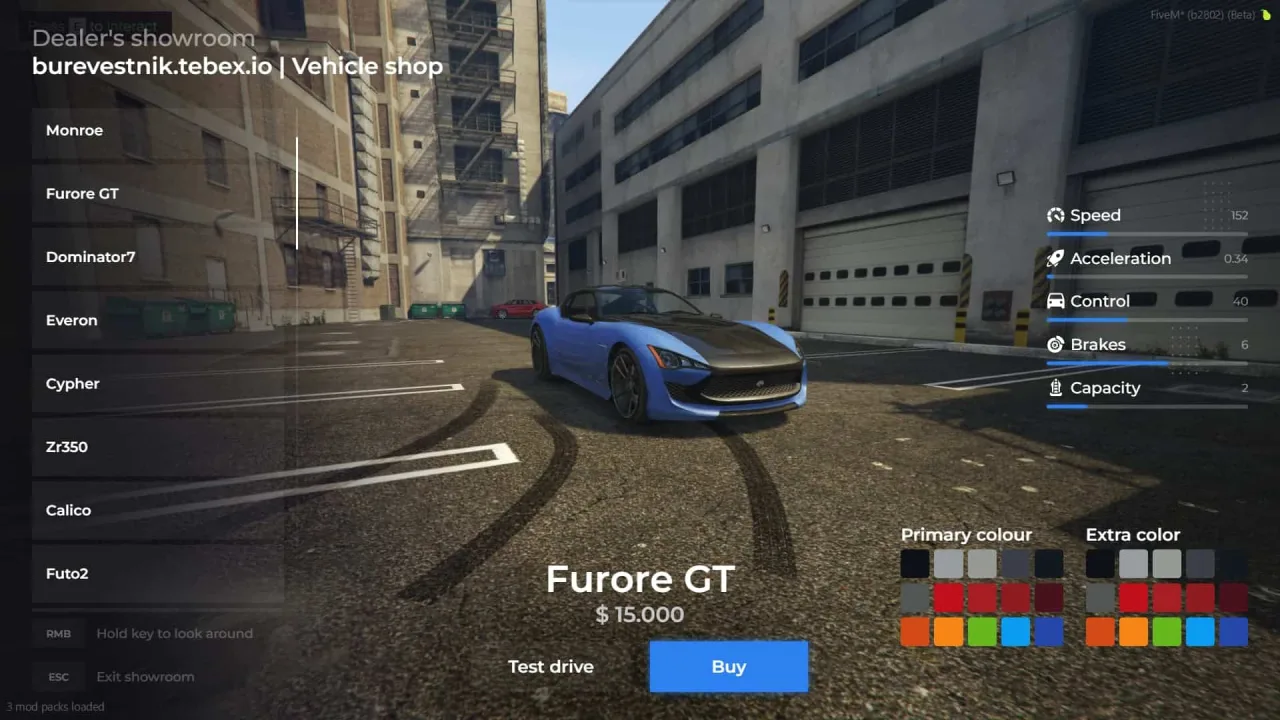
Every server wants a huge car list. Almost none of them need one. A dealership with three hundred vehicles isn't a feature, it's a performance problem and a balance nightmare. Curate in tiers instead: a sensible starter tier, a mid tier players grind toward, and a few aspirational high-end vehicles that mean something to own.
Quality matters enormously here. A badly optimized vehicle pack - bloated models, broken handling, missing LODs - hurts your server far more than it helps. Source from creators who actually optimize their models, keep the list curated rather than maximal, and your vehicle economy feels like a progression instead of a junkyard.
Performance: the category nobody budgets for
Here's the line item most owners forget: performance. Once you've got scripts, maps, and vehicles, the thing players feel is your server tick. A server that runs smoothly with forty players beats a feature-packed one that stutters every firefight.
Budget some of your spend - and a lot of your attention - on optimized resources and on replacing the heavy ones you bought early. When a script's resmon cost is high, that's a real tax paid every second of every session. Sourcing from a catalog of performance-focused, optimized scripts when you're choosing the systems that run constantly - HUDs, frameworks, anything ticking every frame - pays for itself in player retention. Smooth is a feature, and it's one players can feel even when they can't name it.
Spend slow, reinvest from real signal
The owners who build lasting servers share one habit: they spend slowly and reinvest based on real signal. They get the foundation right, watch what players actually do, and buy the next thing because the server earned it - not because a store page sold it to them at 2am.
Resist the urge to buy your whole vision up front. Build the spine, ship the core loop, make it smooth, and let the players tell you what to fund next. The server still running in a year isn't the one with the biggest catalog - it's the one whose owner spent deliberately, in the right order, on the things players could actually feel.